
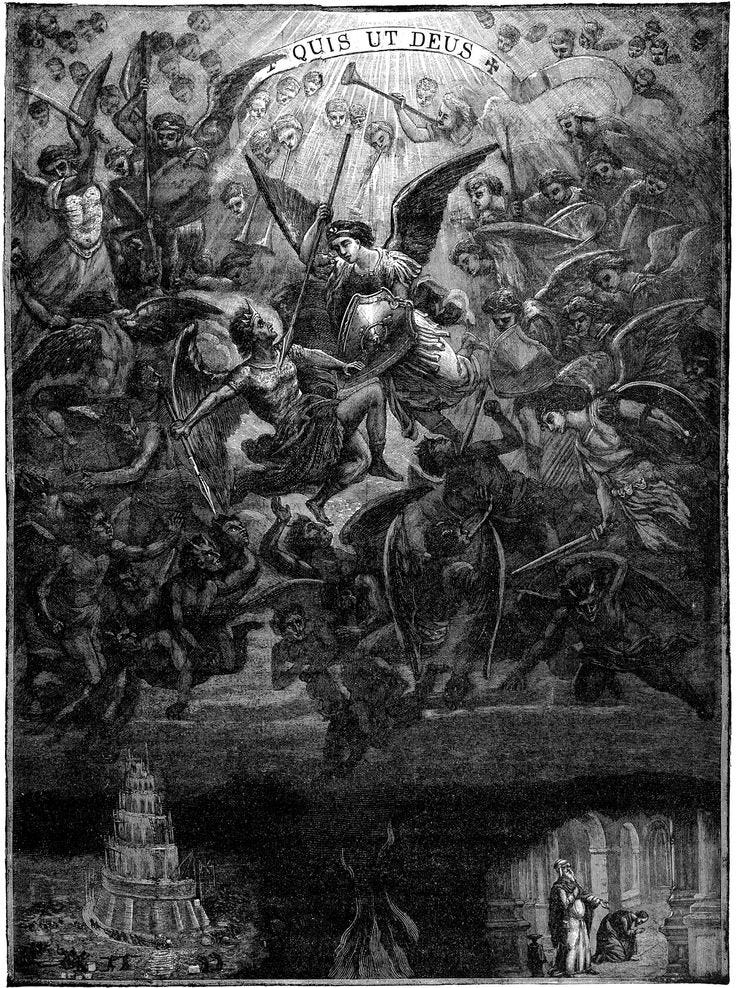
There is a version of this essay that opens with a desert. Fourth century, Egypt, somewhere between Nitria and Kellia, where a Greek-trained scholar, Evagrius Ponticus had gone to live among the Desert Fathers. Having had a complicated life before that, exiled from Constantinople under circumstances that may or may not have involved someone else’s wife, and the desert was where he went to put himself back together. What he produced there, sometime around 375 AD, was not a sermon. It was closer to a clinical manual; a list of eight ‘logismoi,’ or “thoughts,“ that he believed accounted for nearly every form of psychological suffering a monk in isolation might encounter. Gluttony, lust, avarice, sadness, anger, sloth, vainglory, pride.
This is the part of the story people tend to skip, but it is the part that matters; Evagrius was not writing for the general public, nor writing a morality tract. He was writing a diagnostic tool for a tiny, specific population, men living alone in the desert, and the document was meant to help them notice the shape of their own minds. The sins were not crimes to be punished. Rather patterns to be recognised, the better to disarm them. It took two intermediaries to turn that into something else entirely. Student John Cassian carried the list west and translated it for a Latin audience. Then, two centuries later, Pope Gregory the Great folded vainglory into pride, dropped sadness, added envy, and produced something close to the seven we’d recognise today. Somewhere in that handover, the list stopped being a tool a person used on themselves and became a tool used on other people. It went from introspective to accusatory. Gargoyles started getting carved with it and morality plays staged it. By the time it reached the twentieth century it had been fully hollowed out into pure aesthetic, a film called Se7en, a “sinfully delicious” tagline on a chocolate dessert menu. The structure survived. The function didn’t.
What is interesting is that the function did not disappear so much as get reassigned. Consumer capitalism inherited the same eight-then-seven categories of human appetite that Evagrius catalogued, and built an entire economy on top of them, only it is not interested in confession, rather in conversion. The medieval church wanted you to recognise your gluttony and repent. The modern market wants you to recognise your gluttony and buy something that reframes it as self-care. Same impulse, opposite instruction. And the rebrand isn’t evenly distributed. Whether a given appetite reads as a vice or a lifestyle depends, with almost mechanical predictability, on what you can afford.
Gluttony, reframed as treat culture
Gluttony was never really about quantity. Medieval theologians worried less about how much a person ate than about the attention food was demanding, eating too eagerly, too daintily, too often, too expensively. It was a sin of disordered priority. Which makes it the easiest of the seven to watch get laundered in real time, because the laundering depends entirely on price point. The same impulse, more food than is strictly necessary, consumed for pleasure rather than sustenance, reads as a moral failing when it shows up as a value-menu order and reads as self-care when it shows up as a tasting menu. “Treat culture,” the broader discourse around indulgence-as-deserved-reward, doesn’t eliminate the old anxiety about appetite; it just requires a receipt that proves the indulgence was curated rather than compulsive. The global wellness economy, which now spans everything from functional foods to weight-loss services to wellness tourism, reached a record $6.8 trillion in 2024, having grown 35% since 2019, with spending on wellness now equivalent to 60% of all global health and medical expenditure. A meaningful share of that is gluttony with better lighting: $400 omakase, “indulgent” skincare routines, the entire premise of a treat-yourself culture that markets restraint and excess in the same sentence, so long as both are expensive enough to read as intentional.
Sloth, reframed as rest is productivity
Acedia, the original Greek term Evagrius used, didn’t mean laziness exactly. It meant something closer to a corrosive restlessness, the specific despair of a monk who could no longer find meaning in his cell and wanted to be anywhere else doing anything else. It was an affliction of people who had stopped, not people who were idle by nature. The modern wellness economy has rebuilt almost that exact emotional terrain, only inverted into virtue. “Rest is productive” framing, the sound baths, the slow mornings, the permission-granting language around stillness, asks people to treat inactivity as a strategic input rather than a failure of discipline. Mental wellness alone is now the second-fastest-growing wellness sector globally, expanding 12.4% annually, and the US mental wellness market has reached $125 billion, several multiples larger than any other countries. But the permission to rest as a feature rather than a bug is not universally extended. Unpaid stillness, the kind without a retreat or a subscription attached, is still read as laziness. The line between sloth and rest, in practice, is a price tag.
Pride, reframed as authenticity and personal branding
Pride was the sin considered the root of all the others, the thing that made a person mistake their own judgment for the final word. Self-promotion in its raw form has never stopped being socially suspicious; what’s changed is the vocabulary available to disguise it. “Authenticity,” “knowing your worth,” “building your personal brand,” all describe the same underlying behaviour, asserting one’s own importance publicly, but route it through language that frames the assertion as therapeutic rather than vain. This isn’t a fringe phenomenon. The global personal development market, the broad category covering coaching, branding services, and self-actualisation content, was estimated at $48.4 billion in 2024 and is projected to reach $67.21 billion by 2030, while the narrower personal-improvement segment was independently valued at $41.23 billion in 2022, with a projected CAGR of 5.7% through 2030. People are paying, often quite a lot, to be taught how to perform a version of pride that reads as self-respect rather than vanity, and the people best positioned to pull that off are the ones who already had a platform, a wardrobe, and a camera to begin with.
Envy, reframed as manifestation
Envy is the sin Gregory had to add to the list himself, because Evagrius’s original “sadness” only half-captured it; not just sorrow at another’s fortune but a kind of grief at the gap between what you have and what someone else does. Manifestation culture takes that exact gap and rewrites it as spiritual ambition. Wanting what someone else has, expressed plainly, still reads as ugly. Wanting it and calling it “calling it in,” visualising it, vision-boarding it, reads as discipline. It’s worth being honest about scale here: this isn’t a niche corner of the internet. It sits inside a personal development and wellness ecosystem worth tens of billions of dollars annually, and inside a content economy where aspirational, lifestyle-adjacent material is some of the most consistently rewarded material on the platforms that host it. The psychological work being done is genuinely old, want examined and reframed as want sanctified, but the delivery mechanism is new enough that it doesn’t yet feel like what it is.
What the rebrand costs us
The two sins I have left out, wrath and greed, don’t map onto this frame quite as cleanly, mostly because their modern reframing runs through power rather than price. Greed becomes “ambition” largely for people who already have resources to be ambitious with; wrath rarely gets rebranded at all; it just gets selectively excused depending on who’s expressing it. Worth naming, not worth forcing into a four-part structure that doesn’t quite fit. What ties the four that do fit together is this: Evagrius’s original list was built to help an isolated person catch themselves mid-pattern, gluttony, sloth, pride, envy, named honestly so they could be examined rather than acted on. The modern economy took the same four categories and built an entire infrastructure designed to do the opposite, to intercept the moment of self-recognition before it becomes uncomfortable and sell you a product that lets the discomfort resolve into virtue instead. The monks wanted the sins noticed. The market wants them spent.
There’s a version of secular modernity that likes to tell itself it left this kind of moral bookkeeping behind in the medieval period, gargoyles and all. It didn’t. Instead, it stopped asking you to confess and started asking you to check out.